Tuesday, 8 September 2015

New Series

We're back at work for a new series.  I seem to have been recast over the summer and the set is looking a bit different, but it's all testing well with preview audiences so far.  There might be different opening credits but I'm only partially non-diegetic so I can't really tell without breaking the fourth wall a little too much for this early in the season.

Like some hellish rollercoaster of devilfun, I'm attempting to run Ghost Transmissions as a straight dive right down from here to Halloween, unless I get distracted by sequins or someone waving a laser pointer near me.  Since we're starting this Bradbury-esque meta-ramble in September, let's take a look at the world outside my window.   Well, there's a skip, my car, a woman talking to a cat, my cat looking angrily on at this, and the woman in question turning round to notice me staring at her.  It's like Springwatch or something, this.  Except in Autumn.  We should try and think of a name for that.

When I was merely a small Ghost, I had a primary school teacher who set me a wonderfully evocative task; write an essay called "September", about, well, you get it.  I've never forgotten the way she told us to look at the mist over the school gates, the frost on the yard for the first time and the subtly changing tones in the sun's light.  I've also never forgotten the fifteen minute rant she had about why CND were betraying our country and how nuclear arms were crucial to world peace.  The year was 1983.  We lived in Sheffield.  Threads, people, THREADS.

OH GOD NO THREADS OH GOD WORST THING.  Also, the old town hall was way better.


So I thought about Autumn properly, in formal calendar terms for the first time.  But I'd been aware of the seasons before, just in my own ordering system.  Streetlights on = darktime.  Rain and car lights go blurry = darkestcoldtime.  Vomiting with excitement = Christmas.  Immensely relaxing taking down of decorations and cleaning house = un-named peaceful silent zone after Christmas that I still long for sometimes (check out the Aut kid sighing with relief as the tinsel comes down).

Never had a Halloween, because EVERYDAY IS HALLOWEEN, CREATURES.  I didn't get called on for much at school, but I was always on demand for ghost stories.  I knew loads and I still do.  What used to disturb me was that the other kids would demand I tell them specific stories that I'd told them before...except I hadn't.  They were completely new to me.  Self generating memetic supernatural invasion incident!  Definitely.  Where was I?

This time of year was when decent Saturday morning kids' TV started again, but you can read all about that in a hundred other places.  As soon as there were more than ten sites talking about Tiswas, it lost the mystique somehow.  I'm not interested in interviews and nostalgia in this form; I don't want to know behind the scenes production details.  It's the fevered, half-remembered dreamland of TV that I want.  The Ghost Transmissions, in fact.

So, we're now moving into darktime, to talk like a pretentious 9 year old GhostTransmitter.  That edge of cold creeping in and the sense that there's a world moving and changing outside the curtains.  Scene shifting behind the magic curtain.  You know it's really darktime when you have to shut the turn the lights on before it's time for John Craven's Newsround.  (Brief distracted moment of hauntological ecstasy over the Radiophonic Workshop theme tune).  The dark feels safe, as I said earlier this year.  Safest I felt when I was a kid.

 - And then, years later, being in sixth form college, seeing the sunset against the woods outside the window on a late lecture, the sudden rush that I was alone and didn't know where I was going anymore - nothing as intense, or as sad, or as beautiful as that feeling, the two or three times since that I've felt it - 

All those people leaving home.  We migrate in Autumn for some daft reason.  Leaving home, going towards the cold, not caring.  The excitement of being eighteen and living in one room on the edge of Rusholme and Moss Side, the cold wind and bright sunshine.  In Manchester!  That must have been the last fucking sunshine I saw for three years.  All the new students are turning up in Sheffield now.  They have special flats with heating and everything.  I'd tell them they were missing out but they really aren't.  May no-one else ever have to walk to the electricity token machine at 11:30PM.  Now that was an odd and memorable Autumn.  As far as I know.

I'd like to conclude by quoting that legendary old misogynistic right wing shite Philip Larkin (I went through five different adjectival descriptions of him then till I found one that was neither gender specific nor disablist).  In Toads Revisited he talks about the comfort in embracing the dull nature of work and the passing of seasons when "the lights come on at four at the end of another year."

It's cheerful as ever, as he goes on to describing this as the journey "down Cemetery Road" - thanks a bunch Larkin, I used to work in an office on Cemetery Road and never once walked down it without feeling your damp stary presence at my back.  Well sod this.  The lights go on at four because there's a whole world of dark and mad and Halloween capers and fireworks going off in the night.  If the price you pay is getting older, it's worth it.  Me, I'm putting my skull mask on, fitting my glasses over the top and singing the bleedin' undead Internationale (a spectre is haunting Europe.  Do you see?)

This is the very best time of year and I intend to make everyone love it all the more.  Halloween all year round, creatures!  Remember, fancy dress is for life.  The rest is just pyjamas.


Sunday, 6 September 2015

The Penny Farthing and the Tiger

I've been going out on a bike a lot recently ("a lot" means statistically in comparison to the rest of my life so far from birth and is therefore completely accurate and impossible to argue with).  Whilst I bleed out of my eyes on the hills of Sheffield, a great thought occurs to me, partially due to oxygen starvation.  Were I a better human, I would see revelatory images of a better world, Trotsky's last testament represented in glorious transcendental detail.  But it's me, so I saw scenes from a shit 1970s horror film that used to turn up on BBC 1 on a Friday night.

And this got me thinking, as my calf muscles began to liquify.  The role of cycling in the media!  I've spent all day talking about socialism and cycling, which made me terribly happy.  Now for my light desert of - well, bikes in odd places on TV and that.  Um.

Everyone used to have bikes on telly.  Children's Film Foundation kids were always setting off at the start of the holidays on their bikes and finding smugglers or Electric Eskimos (it's a thing, a real thing, I swear).

I have a degree.  It's not a good one, mind.


There's a beautiful bit in the sublime HTV series Children of the Stones (and if you still haven't watched it, why not) when two kids are talking and one offers to show the other around the village.  They can do this because there's a spare bike in the shed.  Just lying around.  A spare bike in the shed because everyone needs a bike when you're a kid.  My brain is clearly not a place for the fainthearted or easily confused, but this sequence makes me inexplicably happy in a way I can't articulate.  I mean, I don't have a spare bike in the shed and my shed is also padlocked up and there's an old George Foreman grill blocking the door anyway.  But just imagine a world where there were just spare bikes lying around.  Actually, this world is Amsterdam and by "lying around" I mean "so easy to nick that it stops being an issue."

Anyway, why is today's title "The Penny Farthing and the Tiger"?  Well, the particular set of images that occupied my visual processing cortex (no really, I stop seeing the real world, it's fairly dangerous for a cyclist) originate in a sympathetic and well thought out exploration of mental health issues.  It's a film called Tales that witness madness.

For the benefit of my fellow neurodiverse, my previous statement was a joke.

Tales that witness madness is a portmanteau horror film, four stories with a linking theme.  The tiger has fuck all to do with the penny farthing, but I like tigers and it turns up unexpectedly in a sequence that I've always enjoyed, primarily due to my vague distrust and resentment towards SOME (I stress SOME) mental health professionals.  Can I spoiler you up?  There's this psychologist who's a dick.  He gets eaten by an imaginary tiger that becomes real.  The end.  That's the framing story.  There's another one about a spooky sex lump of wood.  There's little else I can add to that particular matter.   It's a lump of wood.  It's spooky.  It starts to look sexy.  That's what happens, I promise you.

We're concerned, however, with the segment about the evil ghost and his time travelling penny farthing that possesses people.

I really can't improve on this.  I think that's David Warner.


Just read that last sentence again for a minute.  Bask in its glory.  And then watch as I try to spin this out; there's very little merit in me retelling this one.  The above sentence covers the entire plot.  See, I was about to try and explain it in more detail, but all that happened was that I just said the same words in a different order.  There's this old penny farthing.  Some guy rides it for a laugh.  He gets possessed and travels in time, because of an evil ghost.  I don't know what else to tell you.

Alright, alright, penny farthings.  The Prisoner, right?  My favourite TV show ever apart from all my other favourite TV shows ever?  The penny farthing was the iconic flag and mascot of the enigmatic Village.  The great McGoohan freely explained the penny farthing (about the only thing that he ever did).  He said that it was an ironic symbol of technological progress running out of control.  I love McGoohan dearly but I'm convinced that he's just making shit up as he goes along now, so I'm going to move on.

OK.  Um...there was a kid's book called The Furious Flycycle.  It was advertised in the back of all the old Puffin books that I had.  I never saw a copy.  Never read it.  Can't help you.  Next.

Oh, here's a good one.  The Time Machine.  HG Wells.  The time machine?  It's a bike.  I can't take credit for spotting this, but anyway, it's got a saddle and handlebars and it's really fucking easy to fall off.  It takes you from your everyday street to somewhere green where you can have adventures.  My bike does that too, though the adventures aren't quite as cannibally.  Also, no-one swore at the Time Traveller when he was having trouble on the hills.

Wells was a keen cyclist (so I say in that way you do when you're halfway sure of something but can't be bothered going to look it up) and there is a powerful trend towards the bike as a symbol of working class freedom and movement, especially in the early 20th century, which would tie in with his politics nicely.  Shame he then says that working class people turn into man-eating trolls without help from their social betters, but hey, it's HG Wells and he made my childhood feel happy so he gets away with it.

What else crossed my disintegrating head as I climbed the hills?  This.

We tell kids from an early age to be careful on the roads, and quite right too.  Yet, I can't help thinking that what they actually get told is to beware on the roads, which is quite a different thing.  The roads are lethal.  That's where cars live.  Cars won't stop for you.  Cars are coming to get you.  They might drive right into your school and slap you around a bit.  There's this underlying sense that the car is always in the right because it's big and expensive; pedestrians and cyclists are irritations, distractions, obstructions.   We incubate a sense of fear and submission before motor transport.

Well, that's how I heard it anyway.  I've spent the day surrounded by fearless motherfuckers who don't take any car crap from anyone, so it's possible I may have been listening to the world too hard again.  I blame the cycling proficiency test.

I'm getting a tabard like that, but mine will say "Expropriate the banks"


Sunday, 31 May 2015

Timeout card

I got diagnosed this month.  I'm autistic.

Not the biggest surprise in the world; man who writes blog about minutiae, weird observations and pop culture has ASC.  

For years, I thought I suffered from depression and that this was the main problematical factor in my life.   Now I'm seeing it from a new perspective; my depressions and mood swings coincide with certain other events; for instance, I get both depressed and strangely angry after walking along busy roads or after long meetings, or in brightly lit shops.  More than two hours in a pub or restaurant also seems to trigger this.  My clinical psych tells me that my senses are taking in way more than they should and that the executive functions of my brain aren't able to distinguish what's important.

I took some time, thought about my reactions to the world, made some notes and observations.  Read a lot.  Some thoughts came to me, so I'm going to use this space to talk about them.  It's not the usual material and I genuinely won't mind if you don't want to read it.  Things are tough all over and they aren't getting any better, as Tom Waits once said.

 - Everything is conversation.  Seriously.  EVERYTHING.  If I'm talking to you, my brain is also listening to the music playing in the background and to the traffic noise outside and to the wallpaper and the feel of my socks.  And it's giving it all equal importance; all those things are speaking to me.  Each one has a message.  Today, I was trying to listen to a friend tell me about his daughter, whilst Hot Chocolate were standing behind me explaining their opinions on human relationship theory.  Also, the curtain rail above the firedoor was explaining that it had been removed some time ago and here were the screw marks to prove it.

 - If I shut my eyes at you, it's nothing personal.  It really helps.  Cutting off one sense for a few minutes helps me focus on the others.

 - So does coffee.  Yeah, but we all knew that anyway.

- I have reality hangovers.  Really do.  So, after a social engagement lasting longer than 90 minutes or so, I feel wrecked, morning-after-a-festival wrecked.  Headache, jittery, sick, not wanting to speak to anyone or do anything more complex than staring at YouTube.

- You need to be really, really clear when you explain stuff to me.  Example: "Look over these lists of names.  Put a tick next to the ones that you think should enrol on the literature A-level."

I couldn't do that because no-one told me what to do with the ones who I didn't think should enrol.  I had to go and check.  You put a cross or leave it blank, apparently.  Who knew?

- The telephone is the work of Satan.  I'm poly.  I'm in two long distance relationships.  I NEED the phone.  It keeps me with the people I love.  However, I have a question: HOW THE FUCK DOES ONE USE THE THING?  I interrupt constantly.  I reply by nodding.  My stress level goes through the roof.  I make random sounds or speak in a mumbling whisper.  I make up words.  I forget to listen.  I say "yes" when I mean "no" and vice-versa.  Bringing me to my next point:

- It's another language.  If you've ever been in the situation where you know just enough to get by in another language, you might be able to get this one.  I very, very often feel exactly like this; I'm just following the conversation.  But sooner or later (sooner if I'm tired or there's a lot of other things going on) the words start to confuse me (or rather, the meaning become less and less clear).  I guess that this is a result of the aforementioned lack of processing/filtering ability, but it feels exactly like asking someone for directions in Berlin and losing the thread somewhere around "gehen sie rechts"; I recognise some phrases but any nuance or detail is gone.  

 - I don't know who you are.  Well, I mean, if we've been on holiday together, or been on a picket line or we share a parent, I reckon I've probably got a good idea who you are.  Everyone else will have to put up with my quizzical look as I try to remember your name and why you aren't that other person with blonde hair.  I will stare at you a lot whilst I do that.  One of the few fuckin' times I can do eye contact.  Here's a thing: I've failed to recognise myself in a mirror before now.  If I'm stressed or if there's a lot of stuff going on around me, I sometimes mistake photographs for people.  And not in a funny, old timey haunted house movie way either.

- I'm going to tell you stuff.  I mean, if you've come here to read this, you know how I write.  Thing is, I'm very likely to talk exactly like this in real life too.  What one of my partners refers to as doing 'Wikipedia entry' at people.  The classic stereotype of ASC; I'm going to talk at you, faster and faster, my voice becoming more and more monotone, totally ignoring your anguished expression and, in extreme cases, the fact that you ran off twenty minutes ago.  

- There's embarrassing bits.  Yeah...see, before I started investigating whether I might have ASC, I worried about my mental health.  There are days during when I feel horribly depressed, as I've mentioned, often when I've just had too much input going on.  But there are also times when my frustration takes over.  I thought I was going crazy, punching the wall, banging my head, sometimes screaming or shouting randomly.  Thank fuck I kept this out of sight of everyone else.  I feel very, very sensitive about admitting to this, but it happens.  And now I know that it happens because it's a classic symptom of ASC.  And you know what makes it all worse?

- Pretending to be normal.  Yeah, did this a lot.  I'm not going to anymore.  Now, there's a lot of comedy mileage in the concept that my behaviour up until now has been me trying to be as normal as possible.  

  I would copy the behaviours of people around me; laugh in the right way at the right time, smile at the appropriate points, ask them the same questions they'd just asked me.  But I'm not very good at this sometimes.  I would start using their accent by mistake.  Or laugh too much when I didn't understand.  Or get the smile wrong, so it all went a bit The Man Who Laughs.  

Expression #34: mild pleasure at an amusing story about someone's dog


  You know what I felt like?  It's an old stereotype, but it's like being an alien, trying to copy the apparently random actions of the people around me.  It's horribly, horribly stressful and it leads right into having a meltdown of some kind later on.  So I'm not going to do it anymore.  This isn't always nice for the people around me, which makes me feel really bad; I talk like a robot sometimes now and that's going to make people feel weird, which is Not Good.  In future, I'm hoping to be able to strike a balance so that I can talk to the people I care about without being either The Joker or the android guy from Prometheus.  

This GIF is making me laugh quite a lot.  Ha.  Ha.  Ha.

I could totally carry this look off.


I suppose it says quite a lot that this is the terminology I use to explain how I see human emotions; using pop culture references to explain important emotional issues is a Thing, apparently.  I'm so sorry that this isn't making the most sense...

- Not making much sense.  Yeah.  You said it.  Well, I said it actually, but you know.

- BIG emotions.  Don't believe all that crap about lack of empathy or coldness.  If something makes me sad, I might cry for hours.  If it makes me angry, I feel like I can tear the city down around me.  Yeah, Hulk SMASH puny political debate.  And happy?  Oh, I can laugh myself into a frenzy, bouncing off the walls at the very oddest things.  The word "tea" for example, is hilarious.  As is the phrase "smoked all them fags" and "please accept this punch in the face".  The other day I remembered that I owned a copy of The Evil Dead on Blu-Ray and laughed for five minutes in sheer joy.  That, my friends, is a bit fucked up, innit?  Ah well, I was cheerful. And terrifying.


Now here's the thing, and if you've stuck with me this long, thanks.

I wouldn't change this for the world.

I like being me.

I see all these crazy patterns in the world.  I get entranced by tiny perfect details.  I think and act and respond to situations like a cat.

How could I want to give that up?  

I can lie awake at night and listen to a thousand little voices of the city around me.  I can replay songs and movies in my head pretty damn close to word perfect and dream whilst I'm wide awake with my eyes open.  I see the all wonder and sadness and beauty and sheer outright screaming joy in the world around me and I can see it all at once, all together rushing into my head and I feel it so hard that it hurts, so that I look and act as though I'm completely insane and I couldn't care less anymore

And that's all.  Normal nonsense very soon. 


Saturday, 30 May 2015

Summer

When I lived with my parents, I'd sleep with the windows open in the summer.  Try it sometime, if you never have; it's worth putting up with the moths just to hear the city at night.  

Sounds drifting in close and falling away again.  You could hear a single three AM car from half a mile away, speeding through and then off somewhere else.  The occasional voice singing, shouting, laughing, fighting.  And when there was nothing else, the voices of the trees, the wind.  I remember lying back, trying to identify each sound; creaking of the wooden fences, dripping pipe somewhere down the road, cat's pawsteps right on the very edge of hearing.  Just now and then, every so often, there'd be the call of a train passing through the tunnel at the bottom of the hill.  The two-tone sound that echoed like a welcoming ghost.  A haunting sound, but not a frightening one.  

I paid such close attention.  I tried to write down what it made me feel like.  I tried to express the joy of living in the city, of the summer heat and the friendly dark and the songs of trains and cats.  Thing is, I also had a black and white TV set and a pair of headphones.  Literary ambitions had no chance because Grip of the Strangler was on again.  And so the world lost a South Yorkshire Ray Bradbury, which is probably a very good thing.

Last time I promised "actual TV stuff" without first thinking through what that would mean.  I'll level with you, I'm a bit short on ideas here.  It's nearly summer now and, just like back then, I don't feel like watching TV.  I feel like watching everything else, or at least observing it all.  The sounds carry so far and I seem to get a bit lost in thought (massive understatement there, I'm sure you'll agree).   Perhaps in the summer we reclaim our days; children are let out of school for six weeks and the luckier of the adults get freedom from work for all of a fortnight.   

In Summer, the light shines through the curtain and reflects on the screen.  All those afternoon matinees, Great Expectations or The Runaway Bus, it's all the same when a quarter of the viewing area is invisible.  The summer sun is brighter than the telly.  There's a rubbish moral right there for you, I suppose.


This has not been the funniest or most in-depth post ever, but, to be honest, I have a fair bit of Serious Life Stuff on my mind right now, events that I'll write about soon.  I'll return to these themes another time.  There'll be jokes and amusing captions and everything.


Whilst we await a return to normal service, here is a picture of a transmitter in the summer.  Sunrise.  See?

It makes me all Yorkshire patriotic.  Sort of.


Bear with me for a while longer, in other words.

Wednesday, 28 January 2015

Night, cities, closedowns and dreams: part 1...


I write about the night a lot.  Not consciously or overtly, perhaps, but the theme is often there somewhere.  It seems like there’s something in the nature of transmission which associates with after dark.  Don’t you just love the language of night?  Dusk.  After dark.  Burning the midnight oil.  The small hours. 

As anyone who’s ever shared a house with me will know, I suffer from night terrors.  These appear to be caused by dips in blood sugar, temperature fluctuations or stress.  The symptoms always amuse me; waking dreams, hallucinations and, funniest of all, mild amnesia.  I’ve woken people up before to ask them what my name is.  My partners are very, very understanding people. 

So you might wonder why I’d grow up with this fascination for the night-time world.  As a child, the nightmares were pretty much constant.  But they were so imaginative!  Sinister carnival barkers.  Deranged puppets.  The Smash Martians.  That big floating evil egg in the garden.  Nightmares haunt humanity, but here’s the thing; if they aren’t anchored in some real life issues, we take one of two routes.  We either outgrow them or we learn to love them.  And eventually, you can make friends with your bad dreams.  They are, after all, just made out of us.  When I stared into the face of the laughing Circus Man, I was looking at a part of my own mind, the same part that hams it up in the classroom to this day.  The puppets?  So loud, my fear of being drowned in noise and loss of control, that I came to overcome.  I’m not really sure what the Smash Martians were.  Probably real, I shouldn’t be surprised to learn.  They eat them with their metal knives, you know.  Actually, with slogans like that, is it any fucking wonder I was terrified?

They've got claws.  CLAWS.


So, the night then.  Fearful.  Fascinating. Streetlights flickering on, sodium yellow: on a cloudy night in Sheffield, the whole sky would reflect that glare back, a burnt orange dome over my world.  My father’s job was to repair and install them.  Once, he took me up on a hillside and switched on a whole streetload of lights, opening a small metal panel in a brick wall and pressing connections inside.  One year, he turned the Christmas lights on, hidden behind a curtain like the Wizard of Oz, whilst the Mayor stood on a podium and pulled a big fake cardboard switch. 

Those nights.  Warm and bright inside, but you could sneak up to the window, press your face against the glass, hidden behind thick brown drapes.  Look out into the rainy night and watch the occasional car pass by, red lights into the distance.  Or perhaps on those long car journeys back home, late on Sunday evening, through the apparently infinite Derbyshire farmland; I’d always get excited to see the city lights again.  I’ve been jumpy in urban settings, but I’ve never had that cold agoraphobic dread that I get in the countryside.  Often, the city feels safe at night.  Home.

Home with all that neon out in the streets, when I moved to the city center.  Home with all those horror films, late on Friday.  Home with crackly black and white, with the sound turned right down.  Home, waking up to the test card around 3:00 AM.  I’m very much at home at 3:00AM.  

I really miss the station closedown.  The last announcement (live, of course), with its sense that the BBC center was sleepy and shutting up shop for the night.  The clock, a public information film, the national anthem (that bit bored me, even then).  Then silence and darkness and a sudden voice warning you to switch off.  What do they not want me to see, I thought.  Because I’ve always been like this.  

And is very probably a Czech animation about a piece of string


That after midnight place feels welcoming to me.  Didn’t you ever look up at an office block, with just a single light on?  Or get the late train and pass a single lit up bedroom window?  There’s such a sad beauty to it, that’s sexy as damnation right at the same time.  Every cat I’ve ever lived with has made a swift exit around half midnight, running wild across the terrace backs, over the night fences and the dark ivy.  

Bright and warm, dark and cold, so very binary, so very wintry.  Summer night is a totally different prospect; I just lose the need for sleep completely somehow.  For the sake of this Transmission, let’s stay in the Winter warm.


As I write this, it’s 1038PM and there’s a blizzard outside.  Nighty night. 

I have more to say on this soon, you'll be delighted to know.  In part 2: some actual TV stuff, along with spooky observations and other random nonsense. 


Sunday, 11 January 2015

January

You take the decorations down.  You clean the house, launder your work clothes.  Put your festival self away on top of the wardrobe, or stuffed into a cardboard box in the attic, labelled in marker and getting dustier by the year.  

The air seems quiet in January.  

Of course, you could always leave the lights up all year.  That's what I do.


Like this.  Coming together, disparate influences merge to signal that transmission's about to start.  Linking.  Solidarity and remembering the future.  This is the new season in Eye TV.


Welcome to 2015.  

Tuesday, 5 August 2014

Controversy...

As I said last time, today we're going to cross a line.  The line of acceptable behaviour and common decency.  This decision will alienate many of my readers, but I can no longer sit back and live a lie.  Therefore, there's something I have to say.

I really like the film version of League of Extraordinary Gentlemen.

There, it's said now.  I can't take it back and I won't, do you hear me?

But "comedy" aside, I'd like to examine my reasoning.  Firstly, let me get something out of the way; I'm very much aware that the vast majority of human beings (a) have never seen the film (b) have never read the books (c) have rather more pressing concerns, like staying alive till tea time and (d) don't read this blog anyway, so fuck it.  Regardless,  Alan Moore has a massive and vocal fanbase and they REALLY don't like this film, it seems.

I like Alan Moore's work.  At this point, under British law, I'm required to talk about V For Vendetta and Watchmen, because apparently, these are the most important comics of all time.  They aren't, by the way.  They're good, they're compelling, they raise powerful arguments about human society/behaviour and they are both so much a product of the 1980s that the film versions should have been directed by John Hughes.

I get awfully bored with people in the media raising these two comics as the highest form of art known to civilisation.  A lot of this seems to be down to the fact that they explore a contained narrative, i.e. they follow the conventional format of the novel and therefore allow a critic to apply the same standards as they would to  PROPER book.  Also, they make the point that super-hero costumes are stupid and unrealistic, which means you can relax and enjoy the fight scenes in a semi ironic way.

It's a bit frustrating that even my critique of these sacred texts is horribly dated; people were saying this stuff in the 1990s.  In all fairness, so was Alan Moore, who's never quite understood why everyone goes on about Watchmen all the time.  I always get the impression it was just another comics gig for him (as many of you probably know, it was intended to feature existing DC comics characters, rather than new ones of Moore's creation).  So we had dark themes and political satire and extreme violence and the deconstruction of the super-hero.  Neat ideas!  And then everyone wrote the same comic for the next thirty years.
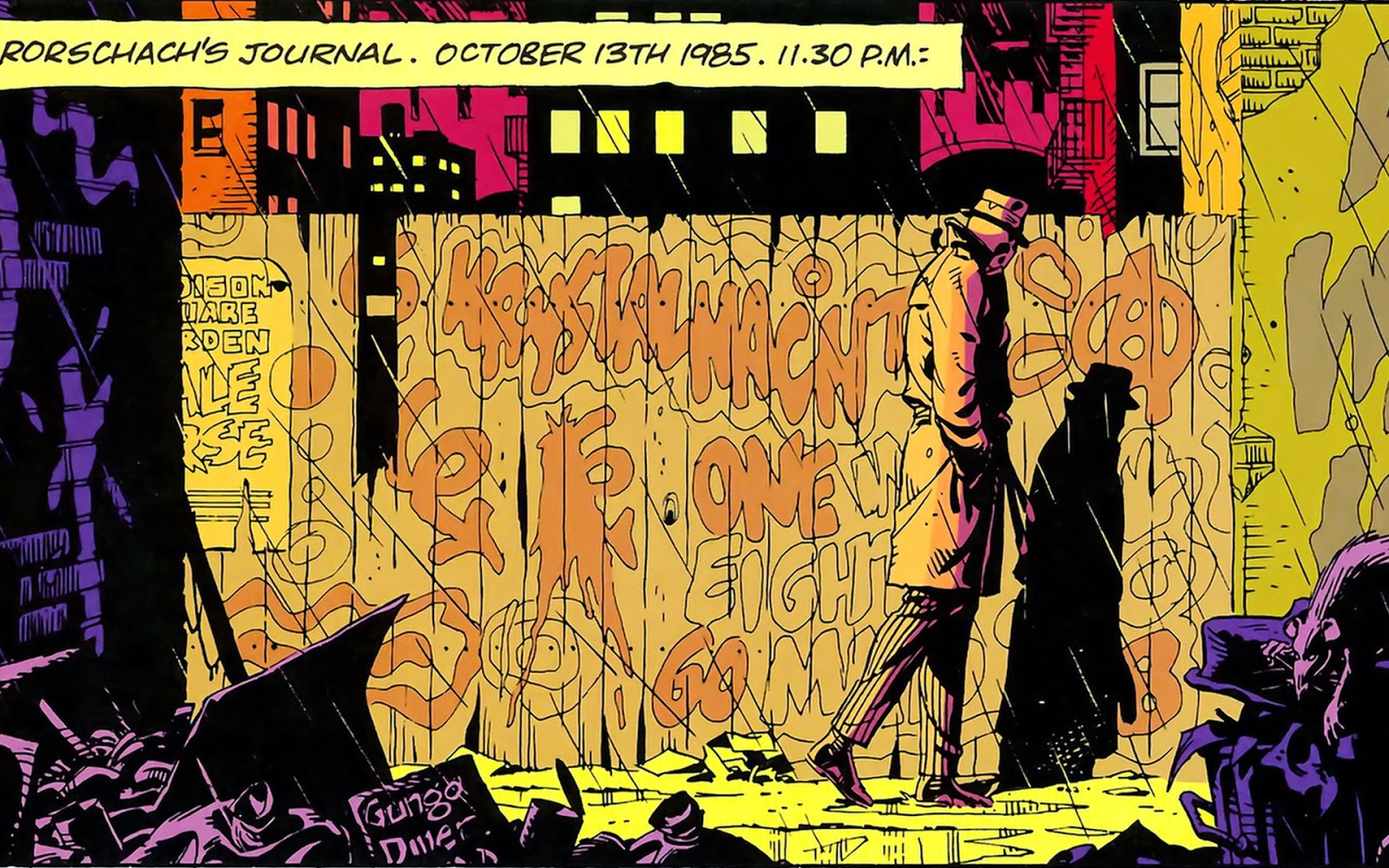
Most super-hero comics are set in Manchester


Not everyone, mind, but it's wearying that we're still having dark, rainy, cynical superhero comics churned out right up until 2014.  Marvel, for their sins, spotted this after five bloody years of dark and "mature" storylines and are currently trying to raise the fun levels, finally noticing that a character called Daredevil might need to be a bit swashbuckling and fun in order to really live up to the title of the book.

There's always exceptions and I'm not going to go on and on (LIAR) about them, but James Robinson's Starman told a genuinely mature story (as opposed to adolescent expressions of crude sexuality, violence and ill-thought out politics) over many years.  Along the way, beautiful characterisation took realistic, likeable characters through dementedly unrealistic situations, with a fair few Bowie references in there for good measure.  Or try Grant Morrison's work; it's sometimes inaccessible, but if you relax and allow comics like Flex Mentallo, The Invisibles or his later work on New X-Men or Batman to sweep you along, you won't regret it.  All these examples toy with the "dark" aspects of comics, but in a way that allows celebration and joy to express itself; what a lot of writers forgot was that, in order to appreciate the darkness, sometimes we have to emerge smiling into the light.


(INTERLUDE: there's a rather a lot of other comics in the world, some of which were written after the year 2000 and aren't about super-heroes.  I could also spend happily spend the rest of this article listing comics you should read that aren't by white men and I genuinely apologise for the fact that I haven't. However I need to get back to that damn film at the top of the page.  Send me angry suggestions about who I should have recommended.) 


Trigger warning: the following section involves some brief comment on representations of sexual violence.  Given the tone so far, I feel it only right to make this clear from the start; it's unavoidable in a discussion of the source material. 


So, League of Extraordinary Gentlemen.  Problematic, in a word.  Problematic.

I own all the collections.  I've re-read them a lot.  My favourite is the one that gets the worst press, Black Dossier, largely because it doesn't really feel the need to pretend to be anything other than a massive "spot the famous literary/pop culture icon" game.  I like the artwork and the sense of style and the dialogue, even though it often becomes just a string of postmodern jokes.

The thing is, the books also make me uneasy.

League runs for four volumes, all of which explicitly depict acts of extreme sexual or sexualised violence against women.  The books feature two central ongoing female protagonists (and one character who regularly shifts between bodies/genders, Teirisias style) both of whom are subject to sexual assaults in every storyline they feature in.  There's an argument that Moore is reflecting the role of women in the literature he is using to build his world; an excellent point about representation, true, but I just don't feel comfortable with the need for Voldemort to be portrayed as a rapist.  It doesn't advance the plot especially, except in a fairly minor way; by the time I reached this part, my reaction was one of weary despair that Moore was using this routine yet again.  Likewise, I understand the allusion to Pirate Jenny in Century: 1910 but I found the scenes based on this as far too horrifying and exploitative to sit comfortably with the explosions and jokes, especially in a comic that uses Jack the Ripper as a central character.

I think there's a real danger that Moore is using rape as a lazy character development technique; worse yet, it seems to be the only technique he makes use of with his female characters, who seem to fall into victim status with grim regularity.  I'm not certain if he's referencing the melodramatic "perils of Penelope" motif with Mina, but if he is, he's not referencing anything else at all.  Re-reading the first volume, specifically some of the Invisible Man sequences, is an uncomfortable experience to put it far too mildly.  I'm not even going to reference the depiction of that character's death, which has clearly been set up as a just punishment for his earlier outrages, but simply seems to compound the horrors.  Suffice to say that Moore seems to have a rather unsettling obsession with this kind of material; for me, the mix of high adventure and misogyny is far, far too representative of the worst elements of pulp culture.

I'm very much aware that this is not nearly enough or enough of a serious treatment of a huge and complex issue.  There is, clearly, a much wider discussion to be had in a more appropriate format.


Sensitive subject matter ends here

And, if you'll forgive a shift in my own tone away from the serious issues, he has clearly never properly read a Harry Potter novel.

Which brings me to the film.  The above mentioned James Robinson is credited with a large proportion of the script.  I feel a bit sorry for him.  He gets his first major Hollywood deal, is handed a legendary comic project and then gets told that they've just lost the rights to one of the main characters (Fu Manchu turned out to be in copyright still.  And racist).  Then the poor bugger reads the comic again and notes how a lot of it appears to be about an emaciated opium addict going through withdrawal.  And how the plot hinges around at least three sequences of extreme sexual violence.  And that a lot of the characters just stand around saying things until the reader notices which nineteenth century novel they're from.

Given all this, Robinson took the best possible course of action; which is clearly to think sod it, I'm writing my own version.  Actually, I may be doing him a disservice here.  What he does is create something rather interesting, possibly intentionally, probably not.  He creates the cinematic equivalent of the comic.  Just as the comic draws upon a written body of work, Robinson's script draws upon a visual body.  This isn't an adaptation of a book, it's using the same techniques in and on a different medium.

From here on in, I'm going to assume you've a degree of familiarity with the film.

SPOILERS: If not: Allan Quartermain (minus the opium), Mina Harker (with vampire super-powers), Captain Nemo (of roughly the same ethnicity that Jules Verne describes), AN Invisible Man (THE Invisible Man is in copyright still), Dorian Gray (portrayed as a camp version of Wolverine), Tom Sawyer (the Alan Moore fans went ballistic about this addition) and Jekyll/Hyde (the Hulk, but not green) get together on the Nautilus and try and stop someone who really isn't the Phantom of the Opera teaming up with Professor Moriarty to start a war or something.  They have a big battle in Venice and in the Arctic circle.  Lots of things explode.  Venice, incidentally, was built by Leonardo and is about sixty times the size it is in real life.  Everyone there wears those pointy carnival masks all the time and the canals can fit the Nautilus in.  There's a steampunk sports car and a white tiger.

It's bloody brilliant.

This is awesome


Seriously, I'm not being all hipster ironic.  I last watched this movie a week ago and writing this much makes me want to watch it again RIGHT NOW THIS SECOND.

This is also awesome

Back to my earlier point; this is a collage, a cut-up job.  As I said, possibly an unintentional one, but it doesn't matter.  What LXG (to use its Moore-baiting abbreviation) does is take the best bits of Hollywood action films and fuse them into a ridiculous, manic patchwork.  A patchwork made of explosions and submarines.  Best kind.

Awesomer.  


Let me clarify by "the best bits of Hollywood action", I don't mean Die Hard, great as that movie is.  What I'm talking about is a very specific thread of work.  I mean the kind of dated, slightly forgotten about, Sunday afternoon, Christmas holidays, rainy Monday matinee movies.  Quartermain, for example; played by Sean Connery, for starters.  The character as represented here is more like a survivor of the Hammer action classics, like She and Vengeance of She.  Neither of which featured Quartermain, but who cares?

Hell yeah


This is the Bank Holiday afternoon Victorian Disney action hero.  Of course Venice is massive!  It looks exactly like it does in that picture you drew when you were nine!  And as for Mina; what's the point in being Mina bloody Harker if you can't turn into loads of bats?  She positively relishes her power and bloodlust; she's a fantastic, fun character.  It's just a shame that she's the only woman in the whole sodding film, but I never said it was perfect.  She does, however, get this great exchange:


Quartermain: Mrs Harker, I doubt you measure danger in quite the way that I do.
Mina: And I imagine you with quite the library, Mr Quartermain.  All those books you must have read, merely by looking at their covers.


See?

This is just plain brilliant.  It's like dressing up as a pirate.  It's like drawing your own version of the Nautilus and making it the size of an aircraft carrier.  No, it's not great art, but then neither is At the Earth's Core or The Land That Time Forgot or Warlords of Atlantis or The Phantom or your own favourite.  It's a big daft laugh of a film and anyone who expected a straightforward adaptation of the comic needs to seriously consider their grasp of what makes cinema work.  This is referencing all those 1930s adventure serials in a more honest way than Star Wars or Raiders of the Lost Ark did, because it's disposable.  One expects Rod Taylor or Doug McClure to arrive.  George Pal must have been watching over this movie; check out Doc Savage if you don't believe me.

Why how kind of you to notice.  I am indeed fucking fabulous.

I bet a lot of people read the comic and worked out which characters came from books that they'd read or heard of before.

I bet that at least someone, somewhere, watched the film and heard about these characters for the first time.  And then went and read The Invisible Man or 20000 Leagues Under the Sea for the very first time too.  If that happened only once, it was more than worth it.


Monday, 4 August 2014

Loads of words about water

I've been reading about the sea this month.

I'm really tempted just to leave it at that.  However, I'm currently working on a personal goal of being much less inaccessible, so, in order that this doesn't just become a deeply obscure collection of non-sentences designed to make me (and no-one else) laugh, I shall expand.


The following is a stream-of-consciousness ramble about the sea.  It is not focused or coherent.  You have been warned.  


I found myself revisiting The Strange Voyage of Donald Crowhurst by Nicolas Tomalin and Ron Hall this month.  I borrowed a fantastically 1970s looking Penguin paperback from the Hoodlum Scientist many years ago and it's fascinated me ever since.  The tragic story of Crowhurst's solo round the world trimaran attempt has been retold many times, much more effectively than I ever could, especially in this particular biography.  


You can find the full details elsewhere, but Crowhurst was a gifted engineer and self-publicist, a driven and rather difficult man who took on a challenge he was ill-prepared for.  Once it became clear to him that he was (literally) on course for disaster at sea, he attempted to fake the log evidence of his voyage, leading him into what the authors convincingly argue was a guilt driven breakdown and eventual suicide.  


From there, I went on to Bernard Moitessier, who set out at the same time as Crowhurst in a yacht that had been stripped of almost every aspect of modernity, to the extent that he refused transmitter equipment, on the grounds that he had a good slingshot and a supply of film canisters (you put the messages in the canisters, then use the slingshot to shoot them onto the decks of passing ships; took me a while to get that bit).  


Moitessier's The Long Way takes a literal description of his own journey and transcends into a philosophy of existence as he slowly retreats from civilisation, eventually abandoning his own round the world attempt in order not to return to Europe. It's a hypnotic, beautiful book, about the stars and the waves and the sun, a sea-going version of the novels of Antoine de Saint-Exupéry.


   One gets the distinct impression that it took a real effort just to moor up near human beings; there's a sense of the strength needed to re-integrate into any kind of society.   A good part of my therapy has dealt with my own tendency to withdraw from the world and I shudder to think how I'd end up if I had the opportunity of buggering off alone on a boat for a year.  Well, apart from sunk, obviously.


Moitessier describes his early years, learning to sail tiny boats, working on Vietnamese junks and all those other things that make Graves Park Boating Lake look a bit tame.  It was whilst reading these parts that I began to wonder; how exactly does one end up being able to undertake adventures like this?  I mean, the money alone is so far beyond my means to make it impossible, but what about the experience, the training?  What kind of background would you need?  As I say, Moitessier grew up stealing bits of other boats in order to get out on the waves, but would that be an option in the 21st century?  


The feeling grows that worlds like this are increasingly cut off.  The vast majority of people don't get to learn to sail, myself included.  It's mainly on economic grounds, but the fact that I live as far from the sea as it's possible to get probably doesn't help much.  Alright, geography aside, do people who grow up by the seaside get to learn this stuff?  Maybe if you're from a fishing family, or loaded to the point where I'm scared of you, then yes. 


I've no idea where I'm going with this line of thought, except that the sea used to be a working class experience (or at least, one open to all), as recently as the last fifty years, whereas now it's become the domain of the rich, unless you're lucky or up for joining the Navy.  That makes me a bit sad.  


But my mind is incapable of being in that state for long at the moment.  So, fusing social comment and the sea, here's my third ocean going focus of the month, Uncle Walt Disney with 20000 Leagues Under The Sea.


There are many reasons to love this film...


...not least of which, this dialogue:


Captain Nemo: I am not what is called a civilized man, Professor. I have done with society for reasons that seem good to me. Therefore, I do not obey its laws.


He's a steampunk bad-ass revolutionary, is our man Nemo.  Shame they couldn't actually have got a actor of the same ethnicity as the actual character*, but hell, it's James Mason.  The unfairly reviled League of Extraordinary Gentlemen gets it right; guess which film I'm rambling on about next time?


So, um, here's my conclusion; it's right good at sea.  But it's right expensive and might make you go mad, which is all very unfair in historical context, so get a massive steampunk submarine and see it from the underneath part.  The end.


Imagine if I got paid for writing this rubbish. I'd be laughing right now, I would.  Laughing.


*Look it up if you don't know.


Thursday, 15 May 2014

Connecting

All my life, I've loved wires.


Welcome back, by the way.  You've not been here for nearly two years.  I was starting to think you'd given up on me.


It's true.  Wires.  Love them.  They fill my childhood memories.  Snaking cables round the back of the sofa, painted into corners.  Power extension cables to make the Christmas tree lights work, wound round chair legs.  Coaxial lines from the attic, down to the living room. Thinking about it, those were my favourite, the wires that linked the inside and the outside. To overuse one of my already burnt out words, liminal.  Connecting spaces. 

The telephone line was another.  Out of the back of our lovingly cream dial handset, (later a wonderfully bathroom shade of olive green, Sheffield 53997) stapled carefully over the wallpaper, then suddenly out through the splintering wooden window frame, up and away along the pointing to loop out across the street, joining the mysteries of what my memory insists we called a telegraph pole.  Because apparently, I grew up in 1899.  

Think of it!  A cable in your house that connects to the rest of the city, the world.  Somehow like a long unbroken change, a string to pull on that might just make the Post Office Tower shake slightly if you yanked it hard enough.  

(Thirty odd years down the line from these memories, I lay down in a bad place, mentally speaking, and ran my hand down the side of the mattress.  There was a live phone cable secreted across the wall there.  I let it comfort me, let it remind me of all the dark miles outside, all the crackling distance.  Millions of possible voices on the line made me feel less like that room was silent and crushing.  Opening up the gaps, linking thoughts across the ten o'clock landscape.)

Consider that old-school coaxial TV aerial cable.  Stuck snugly in place - coax aerials never click, they squeeze organically - running into and up the wall.  Out into the very dreaming mind of the house, the loft space, where all the family memories end up, stacked alongside Lego and old school books.  Cable that reaches out of the shadows, past the peeling Blue Peter Books:


I actually don't want to caption this.  It's too perfect as it is.


...and out, into the sky.  Straight into the rake of a directional aerial.  Effectively plugging your living room into all the background radiation left over from the big bang, like having a skyhook in your house. Turn on your set after closedown and stare at the echoes of creation itself.   A way in for all kinds of odd ideas.  


I've been away for a long time; things have been interesting.  There's a cat here who takes up a lot of time, too.

My point is, GT is going to be about other stuff now.  Still as many Public Information Films and as much Teddington Lock footage as I can stomach, but also, those odd ideas that got in with the TV aerial.  It makes me feel - 


Wired.

Friday, 8 June 2012

The October Country

I do hope that I'm not just coming back here to do a string of obituaries...

Ray Bradbury died this week.


Before the internet, I was worried about this prospect.  He wasn't a fashionable author in the 1980s; TV news had limited time, I didn't read/couldn't afford newspapers and few of my friends were aware of his existence.  I became scared.  Supposing he died and I never knew about it?  The prospect seemed horrifying.

Which is why it's ironic that I heard of his death through Twitter, hours after it happened, ironic because Bradbury was hugely skeptical of the internet's significance; it took him until about two years ago to agree to e-books of his material.  I'm glad he did, because I want to take a copy of Dandelion Wine everywhere with me in life and also The Illustrated Man and Something Wicked This Way Comes...

Ghost Transmissions is really about the stories that shape us, nowadays.  Bradbury did this for me, but I don't think I can comment better than the swathe of impossibly talented writers who have been talking about him for the past two days; Neil Gaiman talked about how the story Homecoming made him feel as though there were other people like him in the world and that made me happy, because I remember feeling exactly the same way when I first read it.

His stories were fast and emotional and strange; one was never sure what was real and what wasn't.  The tattoo that moves at night, the children who get taught to play the game 'invasion' by the funny voice from the shadows, the wonderful green kite which is actually a wonderful father with green wings...yes, he worked with fantasy.  But not exclusively; remember the old man calling Mexico City to listen to the sound of a streetcar as he dies, or the garbage man who quits when they put a radio in his cab, the better to organise the collection of bodies?

For me, there are two works that stand out.


The Whole Town Was Sleeping is the title given to a piece that forms part of a longer work, Dandelion Wine, but it operates so well as a stand-alone that it's often published as such.  It's a simple, wonderful story, which encapsulates an experience common to almost all of us; the walk home at the end of a night out, as you realise that you have the furthest to go, that you'll have to walk the last ten minutes alone...I won't spoil this one; though it's been copied over and over again, the original remains undiminished.  Read it.

How could I end without my favourite?  As a child, sleeping with the window open, I was awoken by the sound of the trains under the bridge, late at night.  When I stayed back at home for a summer at the age of 19, I heard that sound again and it seemed even more haunting now that I knew I'd be on one of those trains again soon, going away, far away.  It seemed like a great and personal revelation and I wanted to write about it, but I never could.

Ray did.

Something Wicked This Way Comes is the story of those trains in the night and much more; on one level, it's about fear and monsters and wishes that, once granted, drive the lucky recipient into a particularly horrific insanity.  But it's about adolescence and desire and envy, all those things that I felt when I first read it.  And more besides; it's about the envy that age brings, the desire to be forever young, the fear of the dark that waits for us all.  But more again!  It's a book about winning freedom from both the desire of adolescence and the fears of aging.  It's about telling death to go fuck itself and running free down the streets at night, about the moment when you know that the monsters are afraid of you.

Quite apart from anything else, this is where my work dress code comes from


Yeah, I was sad when I heard about Ray.  So were about a million other people.  But he told us to take sadness, cry like mad about it, then laugh like a maniac for the joy of still living.  And not to give a damn about what anyone else thinks.


A minute's noise then, for Mr Ray Bradbury.